Guides & Comparisons · 2026-07-19
How to Choose the Right Crash Barrier: A MoRTH Decision Guide
A step-by-step decision guide for choosing the right crash barrier — W beam, Thrie beam or concrete — based on traffic, alignment, hazard and space, per MoRTH and IRC:119.
Step 1 — Assess the traffic. Identify design speed, traffic volume and the share of heavy commercial vehicles. Higher speeds and more buses and trucks push the design from a normal-containment W beam toward a higher-containment Thrie beam.
Step 2 — Review the alignment. Sharp curves, bridge approaches and steep gradients raise impact angles and consequences, and generally require higher containment or reduced post spacing regardless of average traffic.
Step 3 — Rate the hazard. Identify what sits behind the barrier line — fall heights, oncoming traffic in an undivided section, rigid roadside structures, water bodies, occupied buildings. Severe hazards justify higher containment and, where space is tight, a stiffer profile or concrete.
Step 4 — Measure the working width. Check the clear space behind the barrier. A flexible W beam deflects more and needs more working width; where clear space is limited, reduce post spacing (2 m to 1 m), choose a Thrie beam, or use rigid concrete, which deflects almost nothing but can impose higher impact severity.
Step 5 — Set the containment level. Translate the above into an IRC:119 containment level (N1/N2, H1 and above) and a working-width class (W1–W8), and state both — plus impact severity — in the specification.
Step 6 — Detail ends and transitions. Specify approved end terminals at every run end, and designed transitions at every structure and profile change. These are the most commonly omitted items and the most common inspection failures.
Step 7 — Confirm material and documentation. Require IS 2062 steel, a 550 g/m² hot-dip galvanised coating, and the certificate set (mill test, coating-mass, dimensional) matched to the project's inspection regime.
A good real-world answer often mixes types: W beam along routine stretches, Thrie beam at high-consequence locations, transitioning to rigid parapet at structures — with proper transitions between.
Metal Beam Barriers manufactures W beam, Thrie beam and metal beam crash barriers and the transitions between them, to IRC:119 and MoRTH Section 800. Share your traffic, alignment and hazard details and we will help you specify the right barrier mix for each stretch, then quote it factory-direct.
Related Products
The systems this guide covers
MBB-5045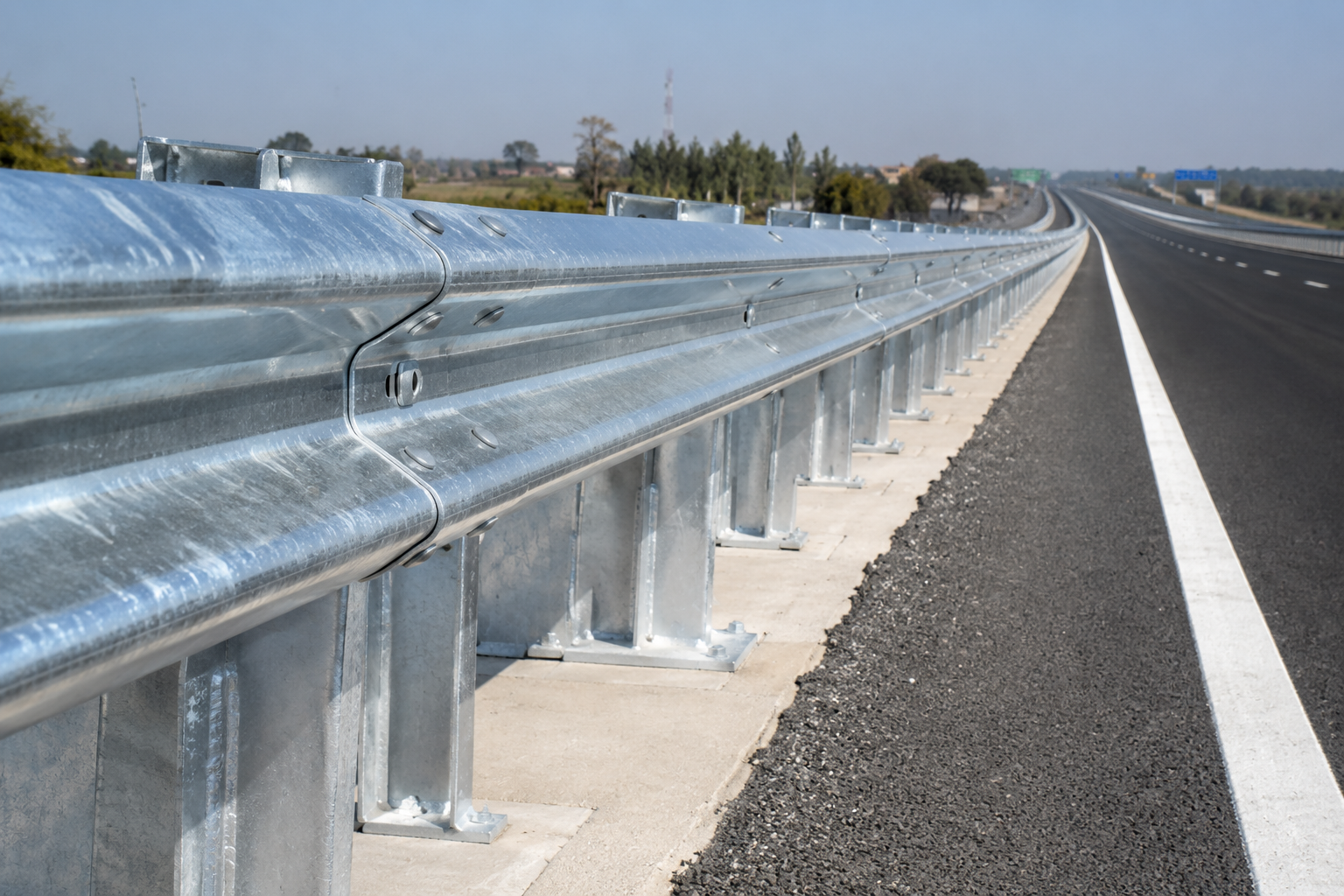
Road Safety & Highway Barriers
Highway Crash Barrier
Highway crash barrier systems designed and manufactured as per MORTH and IRC specifications for highways, expressways, bridges and medians. Available in W Beam and Thrie Beam configurations with hot-dip galvanised finish for maximum durability and road safety.
View productMBB-2613
Road Safety & Highway Barriers
Highway Guardrail
Highway guardrail systems manufactured as per MORTH and IRC standards for highways, expressways, bridges and medians. Available in W Beam and Thrie Beam configurations with heavy-duty hot-dip galvanised coating for long-term corrosion protection.
View productMBB-2751
Road Safety & Highway Barriers
Metal Beam Crash Barrier
High-performance Metal Beam Crash Barriers manufactured to MoRTH Section 810 standards. Hot-dip galvanized for maximum durability and impact absorption on highways.
View productMore Guides
Related Guides & Comparisons reading
Guides & Comparisons · 2026-07-22
What Is MoRTH Clause 810? Metal Beam Crash Barrier Explained
A plain-English explanation of MoRTH Section 800 clause 810 — the clause that defines the metal beam crash barrier on Indian highways — and what it requires.
Read articleGuides & Comparisons · 2026-07-21
Crash Barrier Containment Levels and Working Width (IRC:119) Explained
Containment level, working width and impact severity are the three IRC:119 / EN 1317 properties that define crash barrier performance. Here is what each means.
Read articleGuides & Comparisons · 2026-07-20
Crash Barrier Terminology: A MoRTH and IRC:119 Glossary
A quick-reference glossary of the crash barrier and guardrail terms used in MoRTH Section 800 and IRC:119 — from W-beam to working width, containment to spacer.
Read articleNeed this for a live project?
Talk to the Metal Beam Barriers desk for specifications, pricing and dispatch.