Guides & Comparisons · 2026-07-20
Crash Barrier Terminology: A MoRTH and IRC:119 Glossary
A quick-reference glossary of the crash barrier and guardrail terms used in MoRTH Section 800 and IRC:119 — from W-beam to working width, containment to spacer.
Metal beam crash barrier — the hot-rolled, galvanised steel barrier defined in MoRTH clause 810, in W-beam and Thrie-beam profiles.
W-beam — a rail with two corrugations (a 'W' cross-section); the most common profile, used at normal-containment locations.
Thrie beam — a rail with three corrugations and a deeper section; used where higher containment is required.
Guardrail — general term for the flexible steel-beam barrier along a road edge or median; delivered as a W-beam or Thrie-beam system.
Containment level — the class (N1, N2, H1, H2, H4a/b under IRC:119 / EN 1317) describing the vehicle the barrier can contain and redirect.
Working width — the lateral space (classes W1 to W8) a flexible barrier occupies at peak deflection during impact; the clear space needed behind the barrier.
Impact severity level — A, B or C; the effect of the impact on vehicle occupants.
Post — the vertical support (commonly an ISMC 150x75 channel, or Z/C section) driven into the ground; standard spacing 2 m centre-to-centre, reduced to 1 m at hazards.
Embedment — the depth a post is driven into the ground (broadly 1.1–1.8 m for W beam, deeper for Thrie beam) to anchor impact forces.
Spacer / blocking piece — the block between post and rail that sets the offset and allows controlled deflection.
End terminal — the treated start/end of a barrier run (fishtail, buried-in-backslope, or energy-absorbing) that prevents a bare rail end spearing a vehicle.
Transition — a designed section connecting two barrier types (W-to-Thrie) or a flexible barrier to a rigid parapet, stiffening the run progressively.
Hot-dip galvanising — the molten-zinc coating (minimum 550 g/m² per IS 4759 / IS 2629) that gives the steel multi-decade corrosion life.
IS 2062 — the Indian Standard for the structural steel (grade E250 / Fe410 typical) used in rails and posts.
MoRTH Section 800 / clause 810 — the specification section (and specific clause) covering road furniture and the metal beam crash barrier.
IRC:119 — 'Guidelines for Traffic Safety Barriers', the design framework for containment, working width and barrier selection.
Metal Beam Barriers manufactures W beam and Thrie beam crash barriers and guardrails to these MoRTH and IRC:119 definitions. Send your requirement for a factory-direct quotation.
Related Products
The systems this guide covers
MBB-5045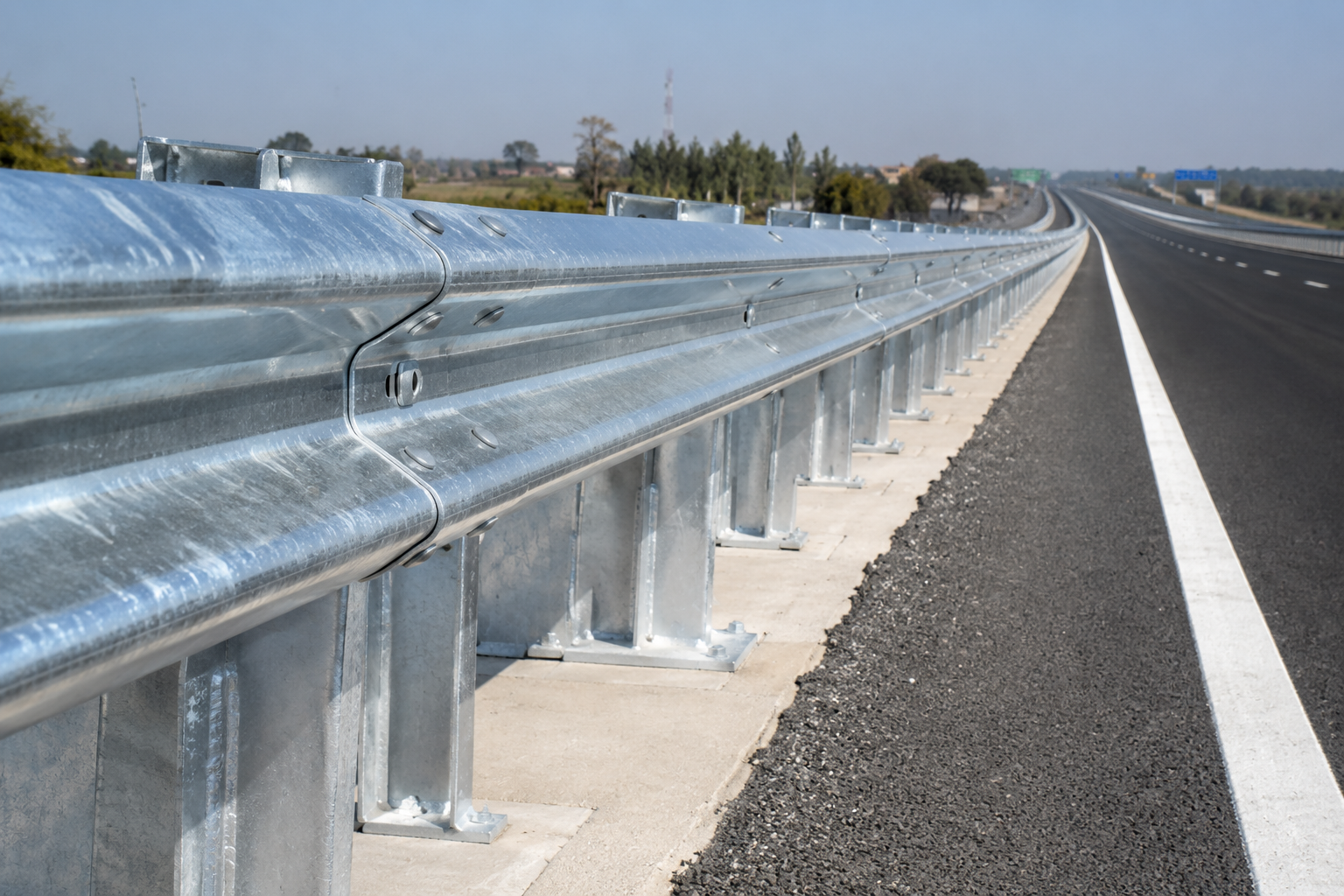
Road Safety & Highway Barriers
Highway Crash Barrier
Highway crash barrier systems designed and manufactured as per MORTH and IRC specifications for highways, expressways, bridges and medians. Available in W Beam and Thrie Beam configurations with hot-dip galvanised finish for maximum durability and road safety.
View productMBB-2613
Road Safety & Highway Barriers
Highway Guardrail
Highway guardrail systems manufactured as per MORTH and IRC standards for highways, expressways, bridges and medians. Available in W Beam and Thrie Beam configurations with heavy-duty hot-dip galvanised coating for long-term corrosion protection.
View productMBB-2751
Road Safety & Highway Barriers
Metal Beam Crash Barrier
High-performance Metal Beam Crash Barriers manufactured to MoRTH Section 810 standards. Hot-dip galvanized for maximum durability and impact absorption on highways.
View productMore Guides
Related Guides & Comparisons reading
Guides & Comparisons · 2026-07-22
What Is MoRTH Clause 810? Metal Beam Crash Barrier Explained
A plain-English explanation of MoRTH Section 800 clause 810 — the clause that defines the metal beam crash barrier on Indian highways — and what it requires.
Read articleGuides & Comparisons · 2026-07-21
Crash Barrier Containment Levels and Working Width (IRC:119) Explained
Containment level, working width and impact severity are the three IRC:119 / EN 1317 properties that define crash barrier performance. Here is what each means.
Read articleGuides & Comparisons · 2026-07-19
How to Choose the Right Crash Barrier: A MoRTH Decision Guide
A step-by-step decision guide for choosing the right crash barrier — W beam, Thrie beam or concrete — based on traffic, alignment, hazard and space, per MoRTH and IRC:119.
Read articleNeed this for a live project?
Talk to the Metal Beam Barriers desk for specifications, pricing and dispatch.